%22%3E%3Cpath%20d=%22M63.318%20472.594c-19.675-.352-60.526%2022.702-63.24-23.015-2.14-36.036%2038.685-24.437%2063.044-29.552%2016.7-3.509%2045.587-10.294%2046.37-17.927%203.823-37.601%2030.1-78.583-6.276-113.497-19.244-18.475-41.934-33.583-59.69-53.258-6.224-6.889-5.363-23.981-1.697-34.249%201.592-4.462%2018.41-3.732%2028.378-4.775%202.322-.248%205.075%201.644%207.32%203.04%2022.401%2014.051%2051.118%2044.738%2065.809%2039.037%2035.593-13.778%2065.562-43.369%2095.544-69.229%206.341-5.466%205.963-22.871%203.38-33.492-3.053-12.564-14.183-23.119-17.353-35.684-2.179-8.624%201.996-19.78%206.223-28.377.927-1.892%2016.192-.183%2021.32%204.097%2016.335%2013.62%2029.095%2032.422%2046.917%2043.068%2014.222%208.468%2035.019%2012.956%2050.545%209.29%207.88-1.866%2012.851-25.286%2015.056-39.598%202.818-18.305-.496-37.641%202.949-55.75%201.526-8.012%2013.608-19.976%2020.145-19.52%207.711.536%2018.344%2011.417%2021.045%2019.924%204.736%2014.965%205.988%2031.56%205.897%2047.465-.209%2038.02%2016.557%2057.303%2054.85%2065.732%2035.084%207.711%2060.448%208.402%2077.853-29.526%209.759-21.28%2026.642-39.898%2042.99-57.186%205.441-5.753%2021.541-7.854%2028.417-3.966%206.38%203.614%2012.056%2019.623%209.185%2026.434-11.351%2026.864-27.542%2051.653-39.115%2078.439-5.532%2012.799-11.534%2033.127-5.493%2041.699%2016.309%2023.093%2031.979%201.879%2046.448-7.802%2022.167-14.809%2043.447-30.987%2066.175-44.804%205.362-3.275%2019.688-2.101%2021.711%201.552%204.357%207.881%207.854%2021.633%203.796%2027.778-11.573%2017.548-26.264%2033.335-41.32%2048.196-14.978%2014.809-44.008%2026.421-45.548%2041.594-3.679%2036.193%204.084%2073.86%2010.412%20110.379.822%204.723%2020.81%209.616%2031.287%208.507%2031.718-3.34%2063.018-11.573%2094.749-13.556%209.654-.6%2027.32%2011.86%2028.455%2020.119%201.318%209.537-9.902%2028.43-18.579%2030.387-35.984%208.115-73.051%2015.004-109.739%2015.095-22.598.066-39.246%203.236-39.312%2025.521-.026%2010.242%2015.226%2024.411%2026.812%2029.995%2022.154%2010.633%2065.745%203.653%2056.703%2040.068-9.798%2039.507-48.861%2017.483-75.869%2013.634-24.881-3.549-46.2-4.54-65.066%2017.731-19.349%2022.859-22.676%2040.094%204.044%2058.83%2017.431%2012.225%2035.15%2025.272%2048.653%2041.372%206.667%207.946%209.512%2028.013%204.175%2034.732-5.923%207.45-26.485%2011.86-34.809%207.176-25.273-14.195-49.345-31.626-70.729-51.236-17.614-16.153-32.631-23.407-56.664-13.791-27.882%2011.168-23.289%2031.665-21.306%2053.037%202.205%2023.693%205.649%2047.53%204.684%2071.146-.287%206.967-13.23%2018.083-21.162%2018.801-8.025.743-20.811-7.085-24.686-14.652-5.78-11.26-4.592-25.873-8.154-38.568-7.502-26.707%2015.826-67.101-37.354-73.625-47.975-5.884-49.801%2027.712-58.908%2057.838-3.014%209.994-6.55%2020.628-12.93%2028.495-4.032%204.971-14.404%208.324-20.706%206.915-6.093-1.357-15.148-9.811-15.056-15.017.352-21.045%204.827-42.012%205.61-63.096.548-14.678%202.596-33.323-5.036-43.356-12.499-16.465-31.392-35.801-49.332-37.745-12.825-1.383-28.808%2023.406-42.82%2037.119-9.499%209.316-16.622%2021.763-27.425%2028.782-7.568%204.919-25.234%207.424-28.365%203.34-6.798-8.885-12.734-24.972-9.016-34.001%207.972-19.375%2020.798-37.367%2034.341-53.689%2020.079-24.189%2033.935-46.109%2012.225-78.035-20.406-30.048-18.279-31.483-80.762-24.79zm514.476-102.707c-.17-64.244-16.883-96.04-57.904-133.773-71.002-65.34-220.98-43.564-281.114%203.132-59.508%2046.226-75.034%20131.006-43.33%20211.494%2037.067%2094.149%20112.063%20151.282%20190.111%20144.693%207.945-.678%2015.865-2.087%2023.68-3.731%20104.325-22.024%20168.857-107.013%20168.557-221.815z%22%20fill=%22%23000%22/%3E%3C/g%3E%3Cdefs%3E%3CclipPath%20id=%22a%22%3E%3Cpath%20fill=%22%23fff%22%20d=%22M0%200h8e2v8e2H0z%22/%3E%3C/clipPath%3E%3C/defs%3E%3C/svg%3E)
Typing in Python (en)
11-02-2026
This article covers two key questions. Why use typing in Python, a language that lets you write without it? And how do you write typed Python code correctly? We will quickly go through the essential tools so that after reading, you can consciously start writing typed Python programs. It is not that hard.
# Dynamic vs Static
So what is typing? For many Python developers, this can feel new, because most classic languages such as C, Java, Rust, and many others were originally designed as statically typed languages. But what does that mean? Let’s look at a small C example:
int sum(int a, int b) {
    return a + b;
}

int main() {
    printf("%d\n", sum(10, 20));

    // printf("%d\n", sum("10", 20));
}
This code works and prints 30. But note that the last line is
commented out. If we uncomment it and compile again, we will get an
error log like this:
error: passing argument 1 of ‘sum’ makes integer from pointer without cast
   10 |     printf("%d\n", sum("10", 20));
      |                        ^~~~
      |                        |
      |                        char *
note: expected ‘int’ but argument is of type ‘char *’
The log says that the function parameter expected int but got
char * (for simplicity, think of it as a string). At first glance,
this may not look surprising for Python developers, because this Python
code would also fail:
def sum(a, b):
    return a + b

print(sum("10", 20)) # TypeError
So what is the difference? Let’s tweak both examples in C and Python,
and call sum with two strings:
print(sum("10", "20")) # > 1020
Here we get no error, because polymorphism works and string addition is valid. But what happens in C?
int main() {
    printf("%d\n", sum("10", "20"));
}
You cannot even compile this program. You get the same error log as
before. Notice how we defined sum in C: we explicitly set input
argument types to int. That means arguments of any other type cannot
be passed into this function. This is static typing. Static typing also
requires a type for each variable and prevents changing variable types
after declaration. In other words, the type is fixed.
The second group is dynamically typed languages: Python, Lua, JavaScript, and others. In those languages, the variable type is not strictly fixed and can change during execution.
# Benefits of Typing
Now to the question: why do we need typing if Python already works well without it? First, speed. At a low level (whatever representation you use), types are always needed. If we do not write them explicitly, it only means someone else does that for us (for example, a virtual machine), which requires resources. That is reflected in language speed rankings:
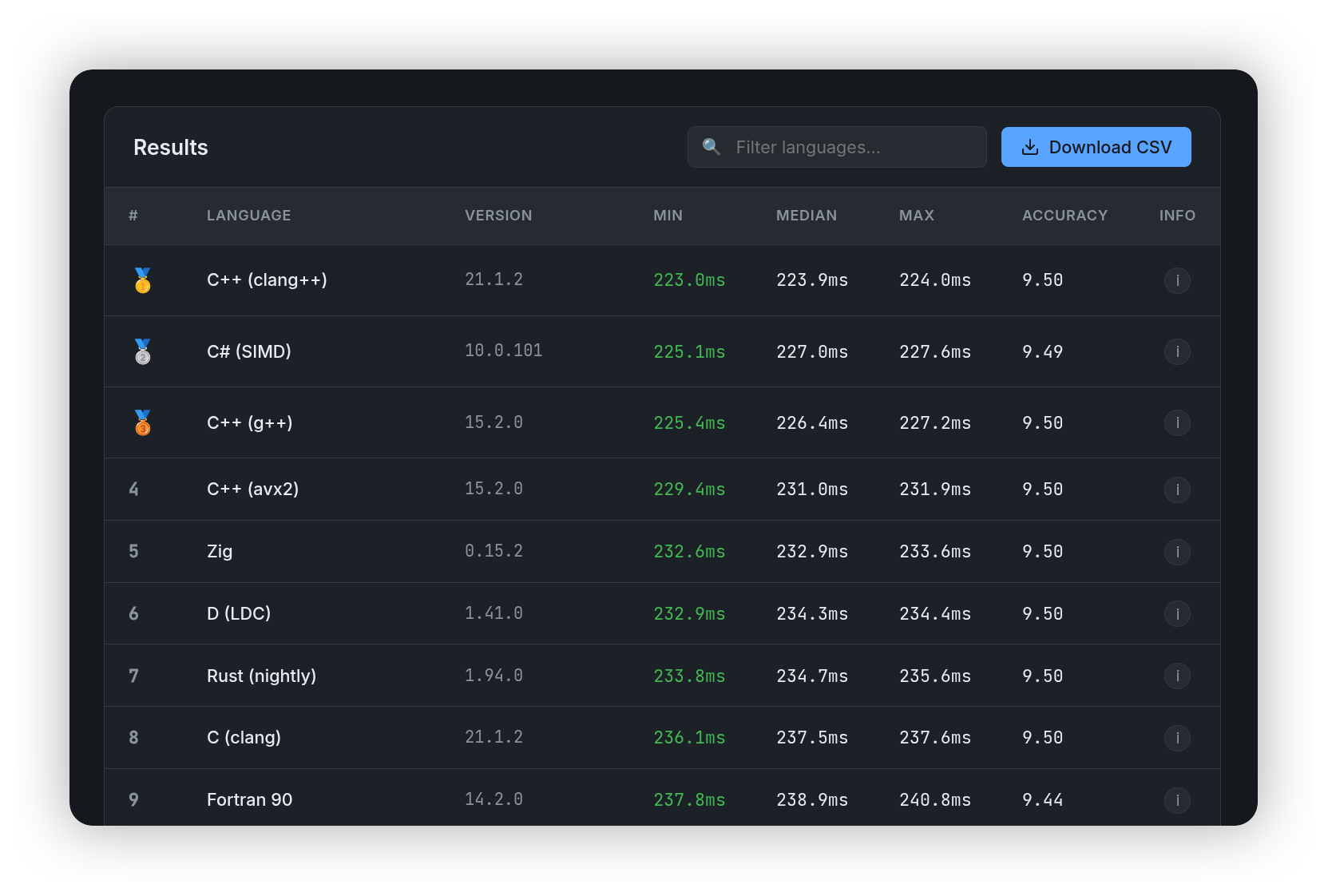
In this rating, Python is at the bottom. Will typed Python fix that? Unfortunately, no. Python was not and still is not a statically typed language. Type annotations in Python remain optional. You can omit them, and the Python interpreter does not enforce them at runtime.
This brings us to the second benefit of types: code quality.
“The goal of typing in Python is to help development tools find errors in Python code bases through static analysis, without running code tests.”
Luciano Ramalho, “Fluent Python”
Extending this idea, typing goals are:
- Early error detection, before runtime and before production failures.
- “Test extraction”: correct typing can reduce the number of tests, which are often harder to write and maintain than types. Tests can then focus on business logic, not primitive mismatches.
- Better readability: PEP 20 says “Explicit is better than implicit.” When reading code, function signatures are often enough without diving into implementation.
- Better IDE workflow with more hints and warnings.
- Better architecture quality: types force cleaner abstractions.
# How to Write Typed Code
Before code, let’s separate three important concepts: interface, abstract class, and protocol. What is the difference?
- Interface is a class where all methods are abstract, with no implementation details.
- Abstract class is a class with both abstract and implemented methods.
- Protocol is an implicit interface.
The first two are straightforward. Let’s focus on the last one. In Python, an interface pattern is usually implemented through inheritance: a class implementing an interface inherits from that interface class. A class implementing a protocol does not have to inherit from it and may not even know about it.
## Primitives
Let’s finally look at how to write typed code. Start with a simple
function that repeats a string n times.
def multi_string(string, n):
    return string * n

print(multi_string("cat", 3)) # > catcatcat
This function takes a string and a number and returns a string built by
concatenating the original string with itself n times. Now type it:
def multi_string(string: str, n: int) -> str:
    return string * n
Syntax is simple: input parameter types go after a colon, output type goes after an arrow. Your IDE can now highlight errors if inputs are wrong or if returned values are handled incorrectly.
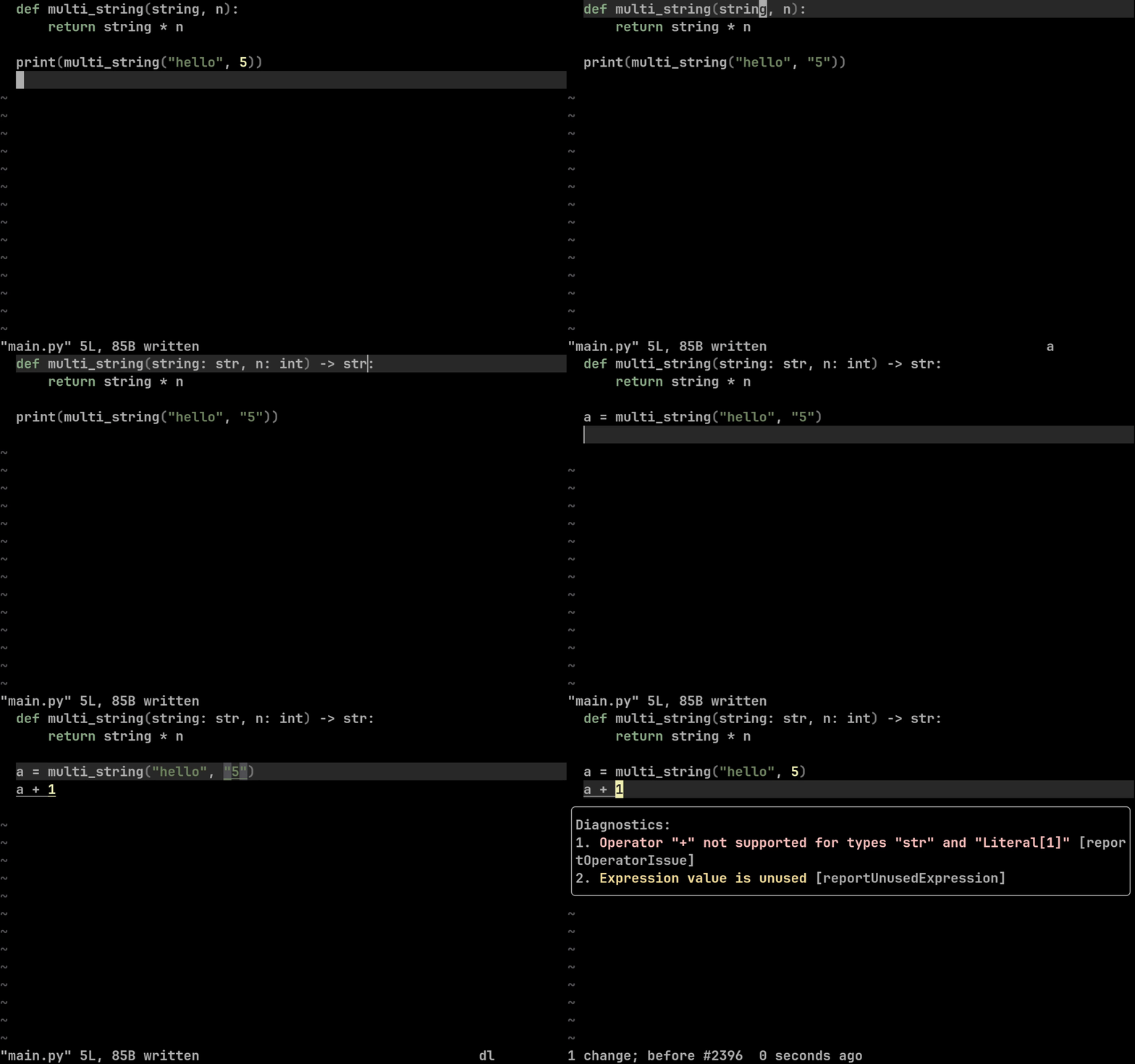
You can annotate all common primitives this way:
str, int, bytes, float, Decimal, bool.
## Union Types
In real code there are more complex cases where a function should accept multiple types, but not arbitrary ones. In those cases use unions:
def normalize(data: str | bytes) -> str:
    if isinstance(data, bytes):
        return data.decode("utf-8")
    return data
Here normalize accepts either a string or bytes and always returns a
UTF-8 string. With union (|), you can list multiple types, but you
should use this carefully. If you feel like writing a long union of ten
types, pause and reconsider. We will cover ways to handle such cases
below.
Unions are also valid for return types, but mostly for optional results. Example:
def parse_int(value: str) -> int | None:
    if not value.isdigit():
        return None
    return int(value)
This means the function result is optional. It may return int, or may
not return one if parsing fails. But annotating returns as int | str
or other unrelated combinations is usually bad practice. It becomes
unclear how to process the result. In practice, return either a concrete
type with known methods/attributes, or None. Breaking this rule tends
to complicate code.
## Collection Specification
Besides primitives, you can and should annotate collections. Avoid plain
data: list; specify element types too. Use square brackets:
def format_user(user: tuple[str, int]) -> str:
    name, score = user
    return f"{name}: {score} points"

def average(values: list[float]) -> float:
    if len(values) == 0:
        return 0
    return sum(values) / len(values)

def total_count(counters: dict[str, int]) -> int:
    return sum(counters.values())
Of course, this does not cover all production scenarios. In TypedDict, NamedTuple, and Dataclass, we extend this toolkit.
## Mapping and MutableMapping
Mapping and MutableMapping are abstract base classes for dict-like
structures. Mapping guarantees read-only behavior (keys, values,
iteration), while MutableMapping says the object is mutable.
from collections.abc import Mapping, MutableMapping

def read_config(cfg: Mapping[str, str]) -> str:
    return cfg["DATABASE_URL"]

def patch_config(cfg: MutableMapping[str, str]) -> None:
    cfg["DEBUG"] = "1"
If a function only reads data, use Mapping. If it mutates data, use
MutableMapping. This is a small but important signal for readers and
type checkers.
## NamedTuple
When you need a fixed set of fields while keeping tuple behavior,
NamedTuple is useful. It is immutable and indexable, but also lets you
access fields by name.
from typing import NamedTuple

class User(NamedTuple):
    id: int
    username: str
    score: int

def print_user(user: User) -> str:
    return f"{user.username} ({user.id}) = {user.score}"
NamedTuple is good for compact data structures that should not change
after creation. If you need mutability and richer behavior, prefer
dataclass or a regular class.
## TypedDict
If your structure is a dictionary and you want typed keys and values,
use TypedDict. It describes dictionary shape and works at static
analysis level.
from typing import TypedDict

class User(TypedDict):
    id: int
    username: str
    email: str | None

def send_email(user: User) -> None:
    ...
This is especially useful when data comes from JSON or another dynamic source but you still want a strict key contract. If some keys are optional, define that explicitly to keep type checks meaningful.
## Dataclass
dataclass is a convenient way to define a data container with
initializer, comparisons, and readable repr. This class is mutable by
default and works well for domain objects and DTOs.
from dataclasses import dataclass

@dataclass
class User:
    id: int
    username: str
    email: str | None = None

def normalize(user: User) -> User:
    user.username = user.username.lower()
    return user
dataclass is a good fit when you need mutable structure and clear data
modeling. If an object must be immutable, use
@dataclass(frozen=True).
## Enum
Enum helps define a closed set of values. This is useful when a field
has a strict list of allowed options and you do not want random strings
in your code.
from enum import Enum

class Status(Enum):
    NEW = "new"
    DONE = "done"
    FAILED = "failed"

def is_done(status: Status) -> bool:
    return status is Status.DONE
This approach is practical for statuses, roles, flags, modes, and other enumerable domain values.
## Custom Classes
The type system can specify not only primitives but also your own or library classes. For example:
class User:
    id: int
    username: str
    email: str
    friends: list[User]

def hand_shake(user1: User, user2: User) -> None:
    user1.friends.append(user2)
    user2.friends.append(user1)
## Abstract Classes
Python has an excellent module, collections.abc. It already defines a
large set of abstract classes that cover most practical needs. They are
useful when you want to describe behavior, not a concrete
implementation. What is available there?
collections.abc.ABCMeta
collections.abc.AsyncGenerator
collections.abc.AsyncIterable
collections.abc.AsyncIterator
collections.abc.Awaitable
collections.abc.Buffer
collections.abc.ByteString
collections.abc.Callable
collections.abc.Collection
collections.abc.Container
collections.abc.Coroutine
collections.abc.EllipsisType
collections.abc.FunctionType
collections.abc.Generator
collections.abc.GenericAlias
collections.abc.Hashable
collections.abc.ItemsView
collections.abc.Iterable
collections.abc.Iterator
collections.abc.KeysView
collections.abc.Mapping
collections.abc.MappingView
collections.abc.MutableMapping
collections.abc.MutableSequence
collections.abc.MutableSet
collections.abc.Reversible
collections.abc.Sequence
collections.abc.Set
collections.abc.Sized
collections.abc.ValuesView
As you can see, there are many abstract classes. Most describe a property of a collection. Using them in annotations lets you express wider polymorphic input boundaries for your functions:
from collections.abc import Iterable

def total(values: Iterable[int]) -> int:
    return sum(values)

total([1, 2, 3])
total((1, 2, 3))
total({1, 2, 3})
Sometimes you still see imports from typing like
from typing import Iterable, Sequence. In practice, those are
re-exports from collections.abc. Today it is better to import these
ABCs directly from collections.abc.
## Sequence and Iterable
These two are often confused. Iterable only guarantees that an object
can be iterated in a loop. No indexing, length, or ordering is
promised. Sequence guarantees iteration plus indexing and length, that
is __getitem__ and __len__. This leads to a practical difference in
what operations are safe.
from collections.abc import Iterable, Sequence

def sum_any(values: Iterable[int]) -> int:
    total = 0
    for v in values:
        total += v
    return total

def head(values: Sequence[int]) -> int:
    return values[0]
sum_any accepts a list, tuple, or generator. head cannot accept a
generator, because it has no indexing and you cannot do values[0].
So, if you only need iteration, use Iterable; if you rely on indexing
or length, use Sequence.
## Callable
Callable is used when a function accepts another function. This is
especially important for callbacks, event handlers, and higher-order
functions.
from collections.abc import Callable

def apply(values: list[int], fn: Callable[[int], int]) -> list[int]:
    return [fn(v) for v in values]
If the signature is unknown in advance, you can use
Callable[..., ReturnType], but this should be a last resort.
## Generics
Generics are parameterized types. In simple terms, these are types that
accept other types. This matters when you want to preserve the relation
between input and output instead of losing it to Any. For example,
first returns the same item type as inside the input collection:
from collections.abc import Sequence
from typing import TypeVar

T = TypeVar("T")

def first(items: Sequence[T]) -> T:
    return items[0]
Without generics, you would write Sequence[Any] and lose output type.
With generics, the analyzer knows that if input is Sequence[str], the
result is str. This is especially important for collections, factories,
and repositories where one implementation handles multiple types.
It is also useful to know that TypeVar has a bound parameter that
restricts which types can be used in a generic:
from collections.abc import Hashable, Iterable
from typing import TypeVar

HashableT = TypeVar("HashableT", bound=Hashable)
def mode(data: Iterable[HashableT]) -> HashableT:
    ...
## Literal
Literal lets you fix exact allowed values, not just a base type. This
is useful when a parameter has a closed set of modes, statuses, or keys.
from typing import Literal

def export_report(format: Literal["csv", "json"]) -> bytes:
    ...
The signature above defines the contract clearly: no third format
exists here. This makes APIs clearer and lets type checkers catch typos
such as "jsno" before runtime.
## Static Analyzers
Now it is time to discuss what makes typing practical in Python: static analyzers. They read annotations, compare them with actual code, and report problems before runtime.
mypyis the classic static type checker for gradual typing. Strength: plugin ecosystem and precise per-module strictness tuning. Weakness: without tuning it can be either too soft or too noisy.pyrightis a fast and clear checker. Strength: good diagnostics and fast feedback. Weakness: plugin-style extensibility is weaker than inmypy.pyreflyis a new fast Rust analyzer. Strength: high speed and LSP integration. Weakness: still young, so some behavior may change.tyis a new Rust tool by Astral (currently beta). Strength: speed and modern architecture. Weakness: pre-release stage; feature set is still catching up to mature checkers.
You can install and run them with uv:
uv tool install mypy
uv tool install pyright
uv tool install pyrefly
uv tool install ty
uvx mypy .
uvx pyright .
uvx pyrefly check
uvx ty check
Here is a business-oriented example with intentional typing mistakes:
from dataclasses import dataclass
from typing import NewType

UserId = NewType("UserId", int)

@dataclass
class User:
    id: UserId
    email: str
    is_active: bool

def discount(total: int, percent: int) -> int:
    return total - total * (percent / 100)

def send_invoice(user: User, amount: int) -> str:
    if not user.is_active:
        return None
    return f"invoice for {user.email}: {amount}"

def main() -> None:
    user = User(id=42, email=123, is_active="yes")
    total = discount("1000", 10)
    send_invoice(user, "500")
Running pyright on this file will produce messages roughly like:
error: Type "float" is not assignable to return type "int"
error: Type "None" is not assignable to return type "str"
error: "Literal[42]" is not assignable to "UserId"
error: "Literal[123]" is not assignable to "str"
error: "Literal['yes']" is not assignable to "bool"
error: "Literal['1000']" is not assignable to "int"
error: "Literal['500']" is not assignable to "int"
What matters in this output:
- Errors in
discountandsend_invoiceshow function contract violations: the signature promises one thing, implementation does another. - Errors in
mainshow boundary-layer issues (input/DTO) passing wrong types into domain logic. - The
UserIderror demonstrates whyNewTypeis useful in business code: a user identifier cannot be accidentally replaced by a plainintwithout an explicit decision.
## Stub Files (.pyi)
Sometimes you want typing for code you cannot or should not edit.
Examples: generated code, third-party library code, or your own module
where you do not want to mix typing and implementation. That is what
stub files with .pyi extension are for.
A .pyi file contains type signatures only and no implementation.
Static analyzers look for these files near source code or in dedicated
types-* packages. Example:
calc.py:
def add(a, b):
    return a + b
calc.pyi:
def add(a: int, b: int) -> int: ...
This way you can keep typing separate from implementation, sometimes even without access to source code.
## TypeAlias
When a type gets complex, move it into an alias to keep signatures
readable. This is especially useful for business terms like UserId,
Currency, or Payload.
from typing import TypeAlias

UserId: TypeAlias = int
Payload: TypeAlias = dict[str, str | int | float]
Then you can write:
def send(user_id: UserId, payload: Payload) -> None:
    ...
In Python 3.12+, you can use the type statement instead:
type UserId = int
type Payload = dict[str, str | int | float]
This is the same alias, just shorter and easier to read.
## TypeAlias vs NewType
TypeAlias is just a type synonym, it does not create a new type.
NewType creates a distinct type at static-checking level, even though
at runtime it is just a wrapper function. This is useful when you have
logically different values of the same base type, for example UserId
and OrderId.
from typing import NewType, TypeAlias

UserId: TypeAlias = int
OrderId = NewType("OrderId", int)

def get_user(user_id: UserId) -> None:
    ...

def get_order(order_id: OrderId) -> None:
    ...
UserId and int are treated as the same type. OrderId is not
compatible with int without explicit conversion.
# How to Use Typing Correctly
Set the right expectation first. Like tests, the purpose of types is to fail when the code is wrong. If they never fail, they are not doing useful work. The less forgiving your typing setup is, the better it protects your code. Strict typing (like strict tests) catches bugs, but only if checks can actually fail.
Writing truly correct typed code is hard. It is a separate skill that grows the same way architecture and testing skills grow. So start small and increase strictness gradually.
##
Returning None
Also consider the case where a function returns nothing:
def print_weather(weather: Weather):
    print("Weather:")
    for date, data in weather.by_days().items():
        print(date)
        print(f"\t{data.temperature}")
        print(f"\t{data.humidity}")
        print(f"\t{data.wind_speed}")
        print("========")

tmp = print_weather(Weather()) + 1
In Python, if a function has no return, it returns None. Static
analyzers know this too. For example, pyright on this intentionally
broken code will show:
error:
    Operator "+" not supported for types "None" and "Literal[1]"
This shows that pyright understands the return type as None. Does
that mean you can skip return annotations? No. First,
PEP 20 says explicit is better
than implicit. Second, consider developer experience (DX) in Python. Everyone
knows typing is optional, so missing return annotation is ambiguous.
When you see a function signature without return type, you cannot tell
whether the author skipped typing or the function really returns None.
You resolve that only by reading implementation details, which slows
code navigation.
## Function Input vs Output
Continuing the return-type topic: avoid using abstract classes from
collections.abc, or custom abstract classes, for function return
types. They are better suited for input types where you want broad
polymorphism. Return values should be concrete so it is clear how to
use the result.
ImportantA function should be more explicit about what concrete type it returns than what it accepts.
If you want to go deeper, here are useful resources to configure your tools and understand Python typing in detail: